Table of Contents
AI grass identification is pattern recognition applied to blade shape, growth habit, seed head, and color signals from a good photo, matched against a large labeled reference library and returned as ranked candidates with relative certainty. The Grass Identifier App is built around that same loop, so the more you understand how the pattern matcher reasons, the more useful its ranked answer becomes on your own lawn.
The assumption to leave behind
Most people picture a grass identifier as a tiny expert that looks at a lawn and just knows. That mental model quietly sets you up for frustration. When the app returns two species with similar certainty, or asks you to try another angle, it feels like a failure instead of what it really is: the honest output of a probability system doing its job.
The truth is less mystical and more useful. A modern grass identifier is a computer vision model trained on a large labeled reference library, paired with a matching pipeline that scores how closely your photo resembles the visual signatures it has learned. It compares patterns, ranks candidates, and hands you a shortlist. The identification is a suggestion supported by evidence, not a verdict handed down from certainty.
Two mental models sit behind this topic, and it helps to hold the useful one out loud:
- Old mental model: a botanist in your pocket that names any lawn from any photo.
- Useful mental model: a pattern matcher that ranks likely species from the visual clues you give it, and gets sharper as your inputs get better.
What works instead
Think of the workflow as a small conversation between you and a pattern matcher. You supply visual evidence. The model returns its best guesses ranked by certainty. You then use context the model cannot see, such as your region, season, and how the lawn is used, to choose between plausible candidates.
Good evidence has a few consistent traits. It is close enough to show blade width and tip shape. It is lit from a soft, even source rather than harsh midday sun that blows out color. It includes more than one structural clue when possible: a blade, a growth pattern, and a seed head if the grass has gone to head. The more distinct signals you show, the fewer look-alikes the model has to guess between.
Strong and weak photo evidence tend to look very different in practice:
- Strong evidence: a single blade in focus against a plain background, soft even light, a second frame of the growth habit, and a seed head when available.
- Weak evidence: a wide overhead shot at midday, mixed species in one frame, motion blur, or a blade lost against busy soil and shadows.
Relative certainty deserves a moment of attention. A top candidate well ahead of the runner-up is a strong lead. Two candidates within a small gap of each other is the app telling you that, from this image alone, the species are visually close. That is a prompt for a second photo, not a reason to distrust the tool.
A compact method to follow
Here is a short workflow that works whether you use a phone camera, a dedicated app, or a mix of both.
- Pick a healthy, representative patch. Avoid burned edges, shaded fringes, and mixed-species borders for the first shot.
- Take a close photo of a single blade against a plain background, such as your palm or a light stone, so the edges are clean. If your framing keeps drifting, a short primer on framing a blade cleanly with your phone camera is worth a few minutes.
- Take a second photo of the growth habit from about waist height, showing how blades emerge and cluster.
- If the lawn has gone to seed, capture the seed head straight on. Seed heads are among the most diagnostic features grass has.
- Note the season and your rough climate zone. Warm season grasses green up late and go dormant early; cool season grasses do the opposite.
- Read the ranked results as a shortlist. If the top two are close, compare their described traits against what you can see in person, especially blade tip shape, vernation (folded versus rolled), and ligule structure.
That is the whole loop. Photograph, review the ranked list, verify with a second angle when the top two are close, and record what you decided so you can build a small history of your own lawn.
When the rule has exceptions
The method above assumes an identifiable, reasonably healthy stand of grass. Real lawns are messier, and a few situations legitimately break the pattern.
Mixed lawns
Many established yards are two or three species blended together, sometimes deliberately from a seed mix and sometimes from years of overseeding. A single photo of a mixed lawn will often return a confident answer for the dominant species and quietly miss the others. If you suspect a blend, photograph several distinct patches separately rather than one wide shot. Because no consumer identifier catches every mix cleanly, an honest read of what free grass identifier apps actually deliver can help calibrate what to expect from any single tap.
Stressed or diseased turf
Drought-yellowed, disease-spotted, or freshly mown grass loses some of the visual cues the model relies on, especially color and blade tip shape. Photograph a healthier section instead, even a small strip at the edge of a bed, and use that for the identification.
Very young or transitional grass
Seedlings have not developed their adult blade proportions, and dormant warm season grass in winter can look almost nothing like the same lawn in July. Boat-shaped blade tips and vernation patterns can still help narrow things down, but when the plant is genuinely between growth phases, waiting for a growth window and trying again is the honest answer.
How the Grass Identifier App - AI Lawn Care & Species ID supports the method
The Grass Identifier App is designed around the same conversation described above. You take a photo, the app runs it through its recognition model, and it returns ranked candidates with a plain-language species description and care guidance tied to the match. The feature that matters most for this workflow is the ranked list itself: when the top two are close, you see it right there, which is your cue to add a second photo instead of committing to a guess.
A few honest limits are worth naming:
- No consumer grass identifier is right every time. Look-alike species, mixed stands, and low-light photos still produce ambiguous results.
- The app is intended as a first pass rather than a substitute for a soil test, an extension office visit, or a landscaper walking the yard.
- Care notes and treatment guidance may include general seasonal advice; treat them as a starting plan you validate against your own conditions.
What that gives you in practice is a ranked candidate you can act on, a species description you can double-check by eye, and care notes that turn a curious weekend question into a plan for the next mow, water, or overseed.
Use the insight in practice
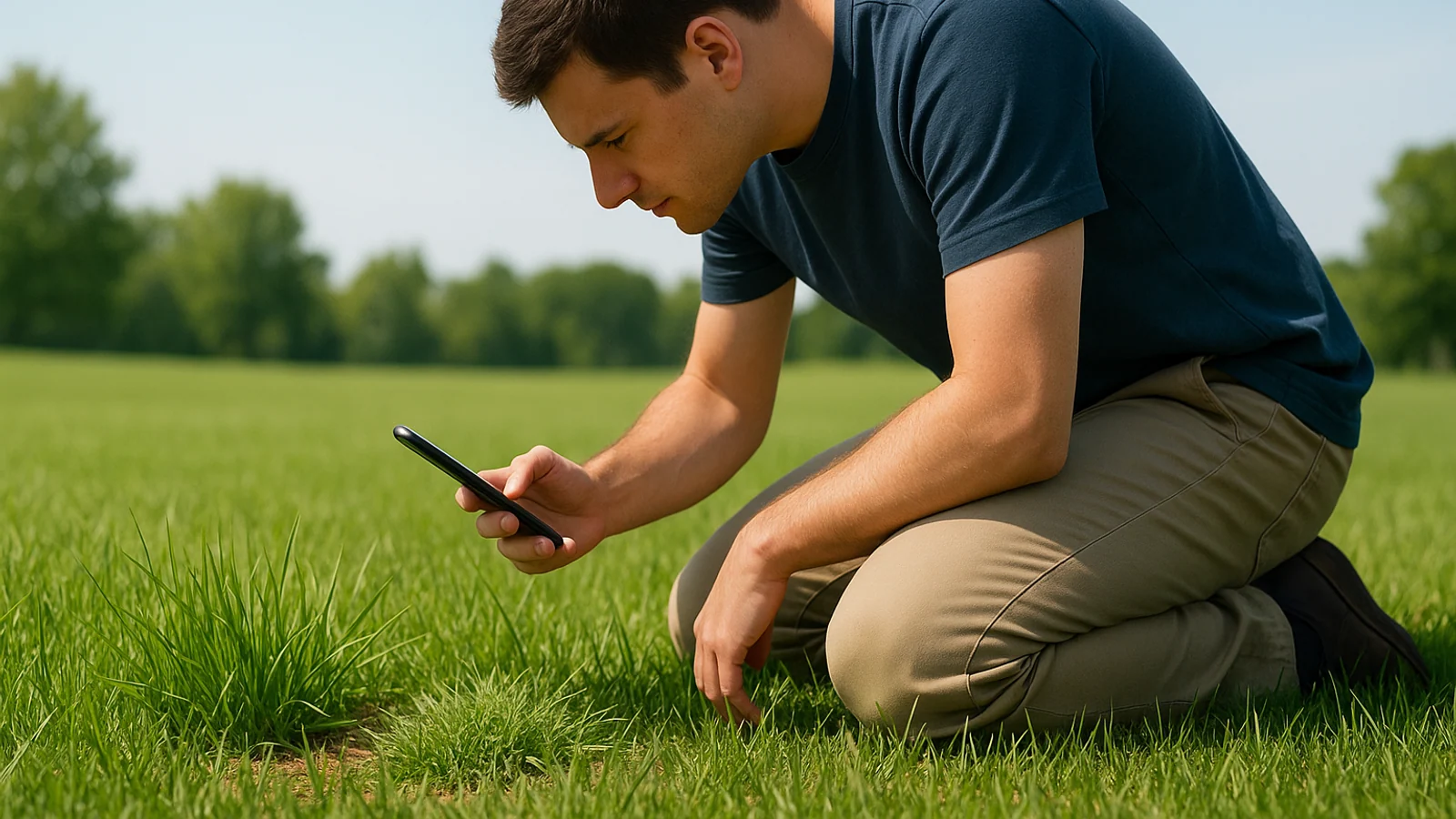
Try this the next time you are outside. Walk to the fullest, healthiest patch of your lawn, kneel down, and take two photos: one of a single blade against your palm and one of the growth habit from above. Read the ranked results as a shortlist rather than a verdict. If the top two candidates are close, take a third photo from a different angle before deciding.
Once you have a working identification, the follow-up questions get more interesting. Is this a cool season or warm season grass, and does your care calendar match it? Are the brown patches you noticed last month consistent with a known disease for that species? Comparing your results against a rubric for judging identifier accuracy on blades, seed heads, and mixed lawns will sharpen how you read a ranked list next time.
The point of understanding how AI grass identification works is not to become suspicious of the answer. It is to become a better partner to the tool, so the ranked list you get back turns into a lawn decision you actually trust.
Related Articles

Free grass identifier apps: what you actually get without paying
A practical guide to what free grass identifier apps actually deliver, where they stop short, and how GrassID's free flow fits into the choice.The

Grass Identifier Apps Compared: A Rubric for Blades, Seed Heads, and Mixed Lawns
For lawn decisions, a turf-focused grass-identifier app like GrassID beats a generalist plant tool. This rubric shows how to test any option using your
How to identify grass on iPhone using your camera
Point your iPhone camera at a healthy blade, let a grass identification app read leaf shape and growth habit, and get a species suggestion in